
How to choose the right binoculars or telescope for your needs.
Choosing new binoculars or a telescope can be an intimidating prospect, even for the more experienced user. What do all the numbers and letters used to denote a specification all mean? We have set out here some guidelines that we hope will be helpful and will make your choice easier.
Choosing Binoculars
How to choose the right binoculars
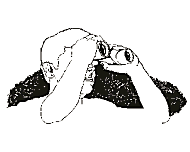 The key to choosing binoculars and telescopes comes down to the ability to test under field conditions, comparing like for like products in an unhurried manner. If you cannot see further than a few hundred metres, and find yourself looking at the inside of a shopping centre or down a high street it’s unlikely you’ll have made the correct choice.
All in focus shops and field events have have the viewing facilities that will allow you to make the right decision, guided by our highly knowledgeable staff that work commission free and have many years experience in both optics and birding.
Choosing binoculars isn’t always easy, and sometimes advertisements make exaggerated claims. Only you can make the choice, bearing in mind price, performance, size, durability, and your own particular needs. At the bottom line, ask yourself ‘Does this binocular feel OK to me?’ If the answer’s a definite ‘Yes’, go ahead and buy.
What do the figures mean?
In all binocular specifications, two sets of figures are supplied (e.g. 10×42). Sometimes there’s a letter as well, such as B or GA. The first figure indicates magnification the number of times the image is enlarged. This is usually 7x, 8x, or 10x,. The second figure indicates the diameter of the ‘objective lens’ – the lens furthest from your eye. (The measurement is in millimetres.) The larger this lens, the more light enters the instrument. It’s this measurement that determines the physical size of the binocular. The letter B means that the eyepieces are suitable for spectacle wearers. You can use these binoculars while wearing your glasses without losing field-of-view.
‘GA’ means that the binoculars are rubber covered to protect them against wear and tear. Some manufacturers use ‘BA’ to mean that the binoculars are rubber-covered and have spectacle wearers eyecups.
The field-of-view is sometimes given in degrees, rather than, for example, ‘140m at 1000m’. A rough guide: 1 degree is approximately ’17m at 1000m’.
What magnification do I need?
Generally, the lower the magnification the wider the field-of-view and the brighter the image the easier to use without a support.So 8x are ideal if you are using a telescope as well, or for woodland use, or at sea, or in poor light. They are recommended if you’re walking, too, being easier and quicker to use. You get good depth of field, and you don’t have to keep refocusing.
10x are the best compromise, however, if you aren’t using a telescope as well. Nowadays they can focus down to about 6 feet as a rule, but are still manageable for distance work.
The higher the magnifications the narrower the field-of-view, the duller the image, the more difficult to hold steady.
High magnification binoculars are more suitable for hide work, viewing at estuaries and reservoirs, and when you’re not using other optical instruments as well.
What type of binoculars do I need?
There are two main body types: the traditional porroprism design, with an angled body shape, and the roof prism (or ‘Dach’) design, with its ‘straight through’ look. Roof prisms may be more expensive. They have internal focusing which is more robust and protects the optics, and they are more compact.
Both designs are available as full size instruments (e.g. 8×42 or 10×42) You can also get them in a more compact form (e.g. 8×32) or as a pocket field glass (e.g. 8×20 or10x25).
Miniature binoculars are fine as backups to your full size ones and when you need them to be small and light. But miniatures don’t have the same light gathering power or field-of-view as the larger binoculars do. Undoubtedly the best for bird watching are the top quality roof prisms.
Conclusions
As well as magnification and type, you need to think about the way the binoculars handle: are they comfortable to use? Is the weight and size manageable? Think about the optical quality, the image brightness, the field-of- view. What are you going to use the binoculars for hide-work, estuary viewing, in woodland or in the garden? Are you going to use them frequently and in rough conditions? If so, you need to choose a durable pair, maybe checking for waterproofing. Are you going to use them for insect watching and long range plant study as well? If so, make sure they have good close-focusing ability.
For general bird watching, go for the lowest usable magnification together with the most compact body shape (e.g. 8×32 or 8×42). If you need high-definition, a wide field-of-view and brightness of image, more than you need to consider size and weight, then try 7×42 or 8.5×42. For hide work, the best bet is around 10×42.
Choosing Telescopes
How to choose the right telescope
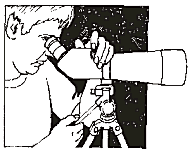 The key to choosing binoculars and telescopes comes down to the ability to test in ‘field’ conditions, comparing like for like products in an unhurried manner. If you cannot see further than a few hundred yards/metres, and/or find yourself looking at the inside of a shopping centre or high street it’s unlikely you’ll have made the correct choice.
All in focus shops and field events have the viewing facilities that will allow you to make the right decision, guided by our highly knowledgeable staff that work commission free and have many years experience in both optics and birding.
Telescopes for birdwatching have become very popular. Once you’ve used one, you’ll see why. They add an exciting new dimension to birdwatching. Unlike binoculars, scopes can be purchased in sections – body, eyepiece, photoadaptor and usually with a suitable support such as a tripod. You need to take trouble over getting the combination of parts right.
What magnification do I need?
Magnifications are available from as low as 15x or as high as 50x, or even higher with some specialist scopes. Some have a fixed eyepiece, usually with magnification of 20x and a relatively wide field-of-view, but many have a range of interchangeable eyepieces to choose from. 20x to 30x wide angle are good for general use, and a 40x may be useful for distance work, e.g. viewing raptors.
At high magnifications you lose image brightness and field-of-view, you’ll need a fixed support, and it’s harder to focus precisely. Eyepieces of 60x and above can only be used in bright light and on a fixed support (for viewing stationary birds). Bigger doesn’t mean better! Variable focus or ‘zoom’ eyepieces work well with some scopes and usually cover ranges of 15-45x or 20-60x.
The most compact scopes have 60mm objective lenses, which are ideal for general viewing, less so if the light is poor. Using a 20x or 22x wide-angle eyepiece ensures that you get maximum light-gathering. There are plenty of versions with larger objective lenses, usually between 75mm and 80mm diameter. These have increased low-light capability, but also increased size and weight. They are at their best with a ‘zoom’ eyepiece, and with high-powered eyepieces of 40x or more you get better image brightness too. Wide-angle 20x or 30x eyepieces also do well on these models.
Basic guidelines
For field work, walking and general observation, try a compact 60mm scope with a 20x or 22x wide-angle eyepiece. For greater power choose a 30x wide-angle or 40x. In low light, or when observing from a hide or any other fixed position, the larger 75/80mm scopes are ideal. You can fit fixed 20x, 25x or 30x eyepieces, or a 20-60x ‘zoom’ eyepiece.
‘Zoom’ eyepieces are fine when you need a range of magnifications, but the field-of-view is less than fixed eyepieces at equivalent magnifications. If you wear glasses, you can get eyepieces with a fold-back rubber cup: you can keep your glasses on, but remember that you may lose some field-of-view.
Straight or angled eyepiece?
Straight
- Easier to use and find birds at first.
- Easier to use with a shoulder-pod.
- Best for hide use or viewing from a vehicle.
Angled
- Easier to watch birds in trees, or viewing downwards, e.g. seabirds from cliffs
- Useful if sketching or using a notebook.
- Your tripod doesn’t need to be so high, so it’s more stable.
- More comfortable for long term observation.
The angle of the eyepiece doesn’t affect the interchangeability of items such as photoadaptors. The choice depends entirely on your personal preference.
Fluorite and ED (Extra Low Dispersion) Optics
Some products are available with ED, HDF or Fluorite glass optics. These are high-grade optical glass elements (used in objective lens construction) offering enhanced image definition, higher contrast and more accurate colour. You can find them across the price range, but they are most effective in top-quality scopes specially designed to get the best out of Fluorite and ED optics.
How to care for your equipment
- Don’t forget to insure your equipment on an ‘all risks’ basis.
- Do NOT let your optical instruments get wet unless you’re sure they’re guaranteed waterproof.
- Don’t let them suffer impacts or extremes of temperature.
- Don’t over-clean the lenses this can damage them, and often does. Just breathe lightly on the lens surface and wipe carefully with a micro-fibre cloth. Don’t use lens cleaning fluids or impregnated cloths, which leave residues and cause smearing.
- If your binoculars or telescope do get wet and moisture reaches the interior, let them dry out in a warm atmosphere and then take them to a specialist dealer for cleaning and servicing. On no account try to do repairs yourself. Letting air into an already moist instrument just makes matters worse.
- If you’re using your scope in the field, do NOT hang the tripod under the scope by using the scope’s stay-on case strap to carry the whole kit. This can prove to be an expensive mistake! Place a tripod strap round the tripod so that the scope sits on top of the outfit.
